


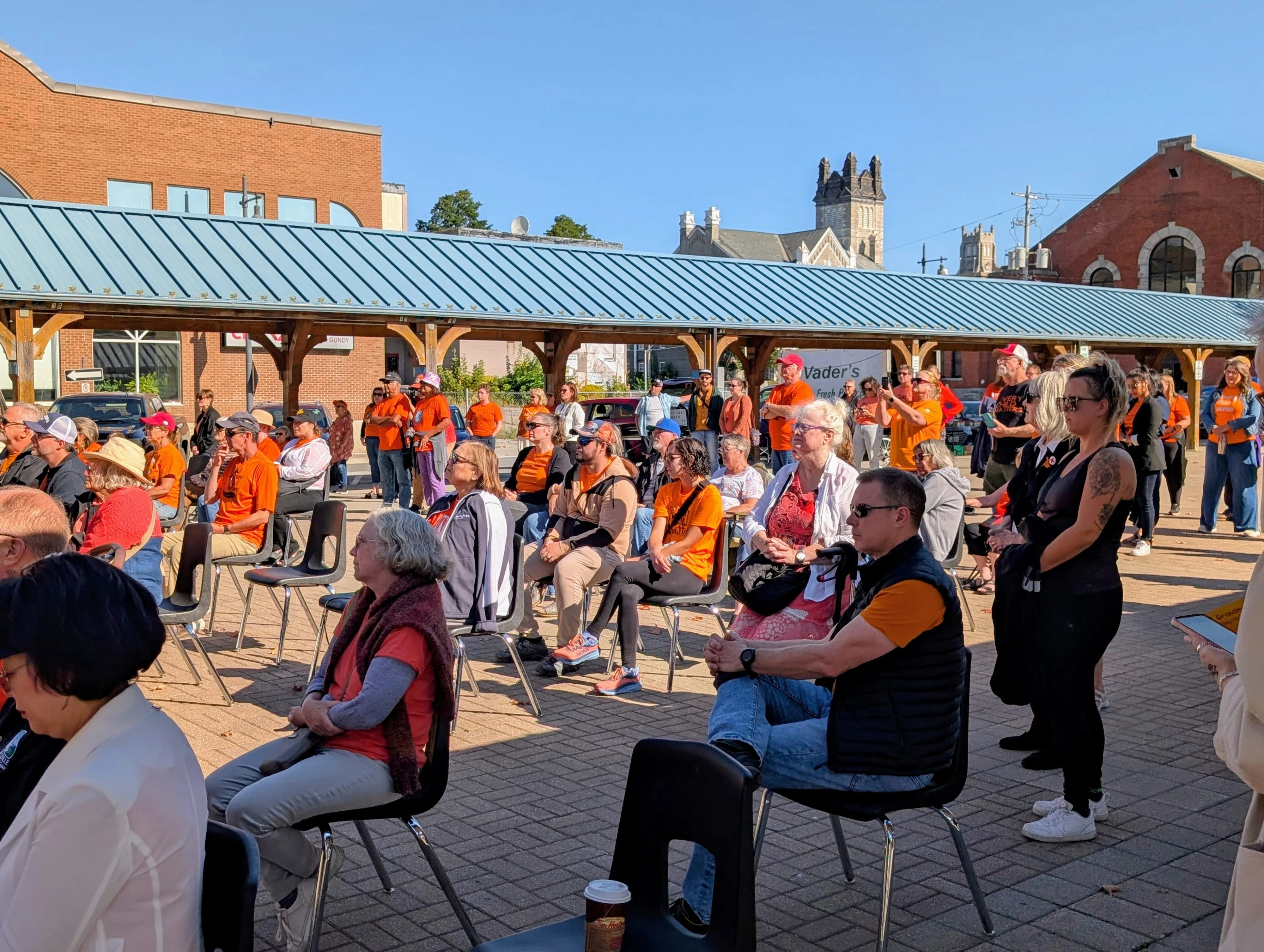
A wave of orange could be seen at Market Square in Belleville on Tuesday as a crowd gathered to mark the National Day for Truth and Reconciliation.
The day honours the survivors of the Canadian Indian residential school system and the Indigenous children who never made it home.
Among the speakers at the ceremony were Chief of the Mohawks of the Bay of Quinte R. Don Maracle.
He spoke about how interconnected First Nations people are with Canada, showcasing a map put together by a cartographer and published in a magazine in 1758.
On the map, Chief Maracle highlighted how the names of Mohawk villages on the map would end up being places we would know now as Belleville and Napanee.
He says the Mohawks have been a part of several wars since the arrival of European settlers to Canada.
“During (World War II), many of the First Nations languages that they were beating out of the kids at the residential schools and the Indian day schools on the reserve. That was the very same language that the Canadian Army used for the code talkers to help defeat the Nazis during the war, because they couldn’t decipher our language. What a contradiction. That’s part of the O Canada story.”
Chief Maracle noted how First Nations people were treated once they returned home from the war.
“When they came back from the war, the government said, oh, the Indian department will look after the native veterans. They never gave them any (money) to look after them, so we had to go to court for the veterans that were still surviving, so they would get justice,” Maracle said.
“They were given $20,000 apiece, and many of them had died, and the Crown didn’t have to pay anything. This is part of the O Canada story.”
He says that more work needs to be done to help the survivors of the residential school system.
“So the challenge today with Truth and Reconciliation is not just to wear orange on September the 30th and wear a button and say, wasn’t that terrible? What happened to those people? It needs an action plan,” Chief Maracle told the crowd.
“First Nations children only have justice through class action lawsuits, whether it’s child welfare on the reserve so they can have the same level of services children off-reserve have, or whether it’s for safe drinking water or to settle land claims for land that’s been stolen from our people or taken without surrender or the lack of basic infrastructure that most municipalities take for granted, or adequate school space for the children.”
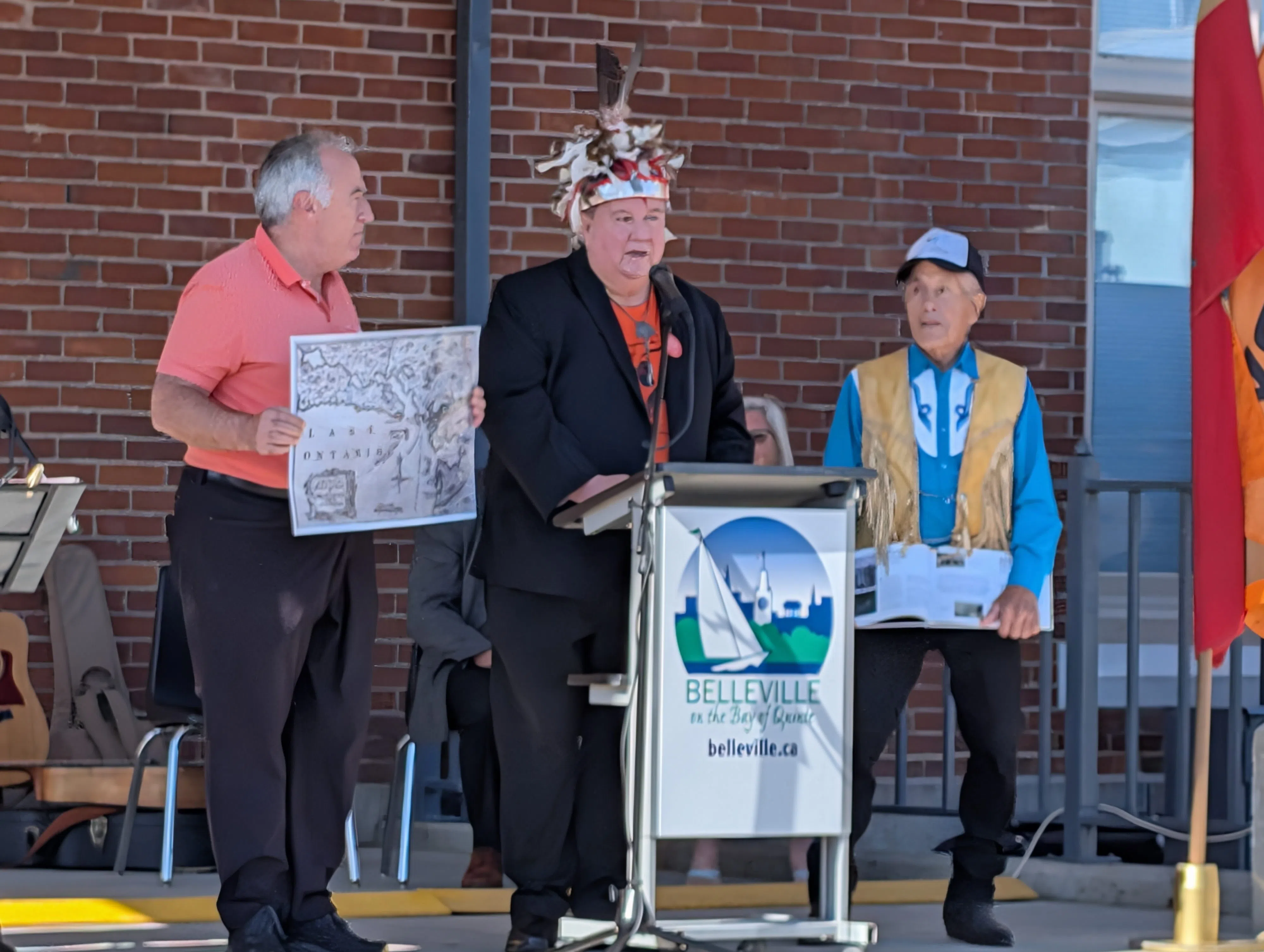
Chief of the Mohawks of the Bay of Quinte, R. Don Maracle, with Belleville Mayor Neil Ellis and Residential School survivor Willbert Maracle on stage for the National Day for Truth and Reconciliation ceremony at Market Square in Belleville. September 30, 2025. (Photo: Zach McGibbon/Quinte News)
Other speakers at the event came from Fire Keeper Greg Loft, Joe Sanford and Fred Leonard.
Musical performances came from Jennifer Brant and Kieran Edwards.
Survivors of Canada’s Indian Residential Schools and their families can find support through the 24-hour National Indian Residential School Crisis Line at 1-866-925-4419.
