



A man who violently assaulted and sexually assaulted a woman at a Belleville hotel over 25 years ago has been sentenced to 13 years in penitentiary.
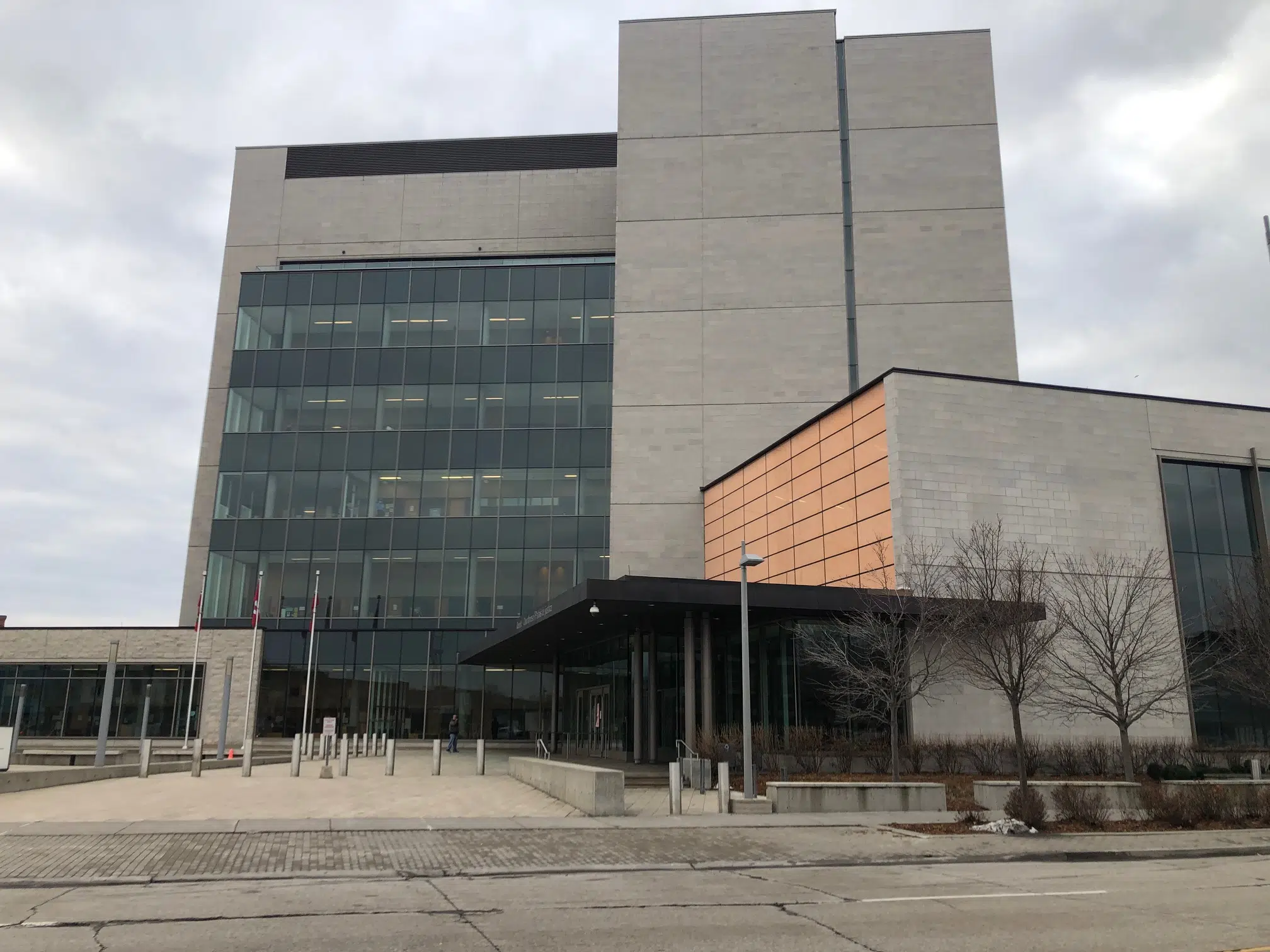
On Thursday morning, in a Belleville courtroom, William James Dale, 47, of Keswick pleaded guilty to sexual assault and assault.
He has been in pre-trial custody for the past five months and was given credit for seven-and-a-half months on the sentence, so he will spend another 12 years, four-and-a-half months in jail.
Crown Attorney Michael Lunski asked for a custodial sentence of 12 to 15 years (15 years is maximum on the charges) while defence lawyer John Wonnacott asked for a 12-year sentence.
Court heard that on July 9, 2000 on the weekend of the then wildly popular Waterfront Festival, the victim, a woman who cannot be identified due to a publication ban, was swimming in the outdoor portion of a pool at the Ramada Inn. She was a member of the hotel’s health and fitness club.
She noticed an unknown man who was smoking watching her from a nearby balcony and greeted him. After finishing her laps she went into the club’s sauna area where she saw the same man again. No one else was present.
The man approached her and hit her in the face six times, ripped her bathing suit off, and violently forced sexual intercourse in a toilet stall.
Soon after, he sexually assaulted her for a second time and disappeared leaving the woman screaming. She wrapped herself in a towel and ran to the hotel front desk where the Belleville Police Service was called. Officers in numbers raced to the scene.
The woman was taken to hospital, badly bruised and with cuts to her face.
Unable to locate a suspect, police seized toilet paper which the man had used to clean both himself and the woman, and a Players cigarette butt he’d smoked. Sometime later, police took palm prints from a door believed to be from the man involved in the assaults.
DNA from the seized items was sent to the public data bank but no hits were received and the case essentially went dormant. However, in 2021, under the leadership of Detective Andrea Boulay and now Inspector Jeremy Ashley it was decided to employ IGG (Investigative Genetic Genealogy).
IGG is an expensive and labour-intensive exercise.
Belleville police had to apply to the provincial government to help pay for the specialized expertise necessary to complete the complex and time-consuming investigation.
The service’s application was so compelling the province provided funding.
It was noted that the lead investigator on scene on the day the assaults took place was Detective Boulay’s father Constable Grant Boulay.
Detail on how investigative genealogy works can be seen below in an excerpt from an ABC News report.
The notorious “Golden State Killer” , Joseph DeAngelo, was behind serial rapes and murders across California in the 1970s and 1980s — but decades passed before a suspect was identified.
DeAngelo became the first public arrest obtained through genetic genealogy, a technique that takes the DNA of an unknown suspect left behind at a crime scene and identifies him or her by tracing a family tree through his or her family members, who voluntarily submit their DNA to public genealogy databases.
To identify DeAngelo, investigators narrowed the family tree search based on age, location and other characteristics.
Once authorities zeroed in on DeAngelo, they surveilled him and collected his DNA from a tissue left in a trash.
Using IGG, the Belleville case became active. A DNA data bank search found similar DNA in what turned out to be an extended relative of William Dale.
Painstaking investigation continued, and by 2024 the search pointed to just one man, Dale. Belleville officers began surveillance of Dale around his Keswick home and managed to seize the butt of a cigarette he’d been smoking.
DNA on it matched that of the suspect DNA taken July 9, 2000. Dale was arrested April 16 of 2025.
Court heard highlights from a victim impact statement. The woman wrote that her life, her freedom, had been “stolen from her.” She was afraid to go out after dark and even in daylight would want to cross the street if a person larger than her was approaching.
William Dale stood and told court, “I’m sorry for what I did. I was drunk. I don’t know why I did it but I did it and I’m really sorry.”
The Honourable Justice Robert B. Horton described the events of over 25 years ago as “horrifying.”
Citing Dale’s criminal record involving assault, sexual assault, and theft that occurred in the 1990s before the Belleville incident, Justice Horton said he did not believe rehabilitation was a realistic option for Dale.
“Everyone has a right to a feeling of safety and security in their community and that was violently taken away from the victim. This court will not stand for these evil acts.
Speaking to Dale, the judge said that he would be free when released from jail but that the victim would live with horrific memories for the rest of her life and that she had been hurt emotionally, psychologically, physically, and financially and would forever live with the scars.
“There is no sentence I could order that would come close to making up for the pain the victim has suffered here at the hands of a stranger.”
Justice Horton took some time to congratulate the police officers involved in the case.
“The police must be commended for their determined and hard work to break open what was a cold case. The community’s residents should be proud of the men and women serving them every day as members of the Belleville Police Service.”
