




The president of the union representing employees at Loyalist College sat down with Quinte News Tuesday, to discuss issues at Belleville’s Loyalist College.
Tracy MacKenzie heads OPSEU Local 420 and she is also a professor at the school.
We chatted about the future of the school and what she calls misconceptions about job losses.
NOTE: We have made multiple requests for an interview with College President Mark Kirkpatrick to offer the colleges point of view. It is a standing and open offer.
QUESTION: In late January, Quinte News broke word of program cuts and staff layoffs at Loyalist. When we did an update to the story over the weekend, there were a lot of people that reached out to me about a large layoff of faculty members. However, the college indicates there are no new planned layoffs and the discussions last week with OPSEU were related to their announcement in the winter. Do you agree?
“We do not agree with that. We were not anticipating to hear about 36 more faculty layoffs. We were told by the college there would be a 20-per cent reduction of staff back in February. With this latest announcement from the college, we will have lost close to 50-per cent of college full time faculty since summer 2024.
QUESTION: Just so we are clear, the college indicated to me the recent announcement is tied to the reduction of 20-per cent of staff back from the winter. Did you anticipate 20-per cent of faculty?
“I think everybody assumed that 20-per cent would be across the board, because we did not see a significant increase in full time faculty, despite the significant increases in international student enrollment in the past few years. We saw significant increases in administrative and management numbers. I don’t think we were anticipating a 50-per cent reduction in full time faculty. I also don’t think that messaging was made clear to the college community by our administrators.
QUESTION: Can you break down the difference in the type of faculty (professors/teachers) at Loyalist?
“This is really important for people to understand, as there are big distinctions between the three groups. We have our full time faculty, who have full time careers at Loyalist. Many have been their for 5, 10, 15, 25 years.
The next group is called partial load faculty. They are union employees, protected by a collective agreement, protected by job security, they have benefits and pensions. While not full time, they are still long term employees, many of whom have been at Loyalist for decades. In many cases, this is their only job, they rely on the job and the benefits and the pension. We had 196 partial load faculty in fall 2024 and we have been told there will be very few partial load contracts going forward. We have also heard that some of those contracts recently offered are now being rescinded.
QUESTION: Can you give us an idea of how many partial load faculty will remain?
“Most of our partial load members are only being offered part time. We are anticipating a significant reduction, definitely more than 50-per cent.
“That third category we talk about is part time. Part time faculty teach six hours or less per week, one or two courses. They recently became unionized, but they don’t have a collective agreement or job protection. They get paid less money, there’s no pension, benefits, or job security and there’s a lot fewer hours. Many partial load faculty are now being offered just a few courses, at a lower salary with no benefits, no job security.
“In order to cover all of the courses there is part time hiring going on at the school. We’re anticipating even more of that with the loss of the full time faculty positions. Somebody’s got to teach these courses. We have lots of courses beginning very soon that do not have any faculty assigned yet.”
QUESTION: In the summer of 2024, how many full time faculty members did you have?
“We had 141 full time faculty. In fall 2024, there were six retirement vacancies the college eliminated. Spring 2025, there were 15 layoffs from our probationary faculty. Also in the spring, we had nine faculty take the colleges Voluntary Exit Incentive Program and those positions were eliminated. Recently, there were three full time faculty resignations, with just one replaced.
“With the college eliminating an additional 36 full time faculty, we have lost 68 full time faculty positions, or 48.2-per cent, since summer 2024. We will have 73 remaining, but we are uncertain about the future.”
QUESTION: Why did you decide to talk with me?
“I am a graduate of Loyalist College (Justice Studies) and I have been teaching in the program I graduated from for 25 years now. I love this community, I love this college and I want to fight for the community I love. I have colleagues that have been at the college for decades. People don’t dedicate that much of their life to a place they don’t love. We are very concerned about what we’re seeing happen and the impact this is going to have.
“Some of the people making these decisions only have two to three years at the school, they don’t have the same skin in the game. We could wake up and find out that your name might be on a list of more layoffs and you’re blindsided.”
“Currently Loyalist has 84 administrators/managers and after these layoffs we’re anticipating 73 full time faculty. How does that support the student learning experience? Faculty are the ones in the classroom supporting our students. We see the challenges they face. We stretch ourselves thin to help them succeed.
“Over the years we’ve seen the decisions being made to invest in new buildings and vanity projects, which is directly having an impact on the quality of education we are able to provide this community.”
QUESTION: Capital projects are long term and can take years to complete. I imagine senior college staff and the board were blindsided by the international student freeze announced by the federal government. When they made the decision to do these projects, the school was likely in a much better place financially.
“Based on how much they were spending on capital projects, that’s fair. We’ve pulled from the audited financial statements over the last number of years. Building enhancement for the 2026 budget is $17.5-million. 2025 was $33.5-million, 2024 was almost $23-million, 2023 was almost $18-million. There was a significant amount of money being spent. You just have to walk around campus to see where it all went. Much of it went to projects that don’t have a direct impact on the student learning experience. “
“There’s also a large amount being spent on new program development, programs that are turning out not to be successful, and they’re being cancelled at the last minute. We’re taking money away from existing programs, we’re not investing in existing programs to make them successful. Instead, we’re investing in new programs with no guarantee they’ll be successful. We’re taking away programs for students in the community that they need and want and we won’t know whether or not the money were spending will be successful.”
MORE BELOW
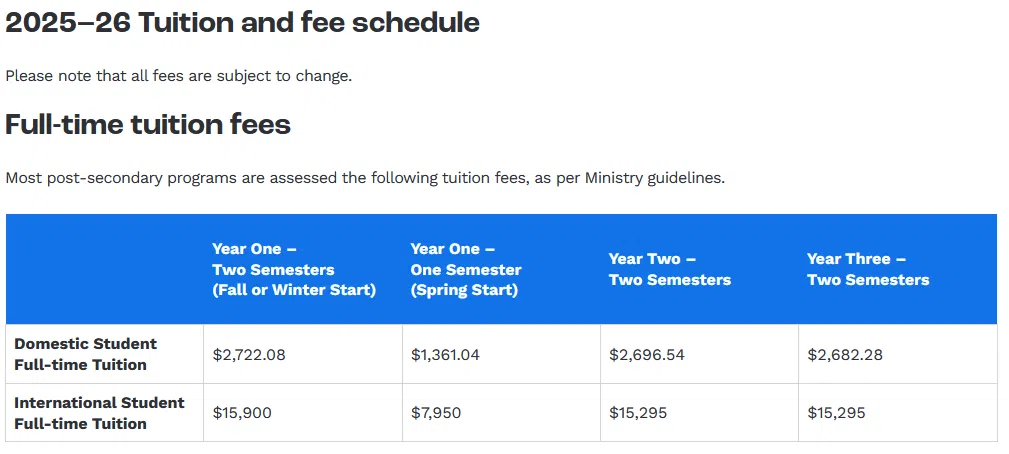
It is understandable why Loyalist College administration was welcoming a lot of international students. The tuition was significantly higher that domestic students. When the amount of students dropped, so did a lot of revenue.
QUESTION: We have hard from many people that the major loss of international student revenue, combined with the low per student provincial funding, made for a perfect storm for colleges. Talk to us about that challenge?
“Over the last ten years, Loyalist College has had a combined surplus of $66-million. When we look through the financial statements all we see is a $65-million G.I.C that was cashed last year and not re-invested. Much of it went to capital operating expenses and some went to cash. A lot of people talk about where did our $66-million surplus from the last ten years go?
QUESTION: Are you concerned the money is gone?
“They are the ones that identified they would be out of money by March 2026. The auditors were only raising the flag about the growing concern language. We reviewed every set of audited financial statements of every other college in Ontario, and we didn’t find any other college with similar language of where we’re going to be in March 2026.”
QUESTION: Was that something the school red flagged or the auditors?
“The auditors red flagged it. We also don’t know whether or not Loyalist College accepted the $25-million emergency loan offered by the province. If they did, we do not know of the conditions that were tied to that loan. Even that money isn’t going to save jobs. In order to protect our students, our programs, we’re the ones that are going to have to fight back and try to save jobs. We’re trying to let the community know what’s going on. We have to do something to save the college we love.”
“If the college is spending millions of dollars developing new programs and building new spaces, while cancelling programs, how does this support students in the community? We know what they are spending on new programs, we know what they are spending on capital projects, so we have to ask are they trying to enhance the campus curb appeal for a future sale of the college?
“Why are they spending so much money to make the school beautiful, but not offering the very core the purpose of a community college is for?”
QUESTION: Who owns the college?
“I know our provincial government is all about privatization. We see more and more post secondary is being privatized. I don’t know why we are spending all of this money to make it look so great and yet we’re not able to continue offering the programs we’ve offered for years.”
“I will give you a good example. Our culinary program. We have a program that’s been training students for years to work in the community, especially Prince Edward County. There is a strong hospitality sector and we can help with work shortages. Despite strong enrollment in the program and despite spending $12-million in 2023 and 2024 to build a new bake lab and change room and restaurant, this past February they announced the suspension of that program. Students were relying on that, the region needs qualified graduates, there was strong enrollment, and we invested a significant amount into capital and a short time later we cancel that program. How does that support our community?”
